
Calista primary
positive behaviour support
WHAT IS POSITIVE BEHAVIOUR SUPPORT?
WA Positive Behaviour Support recognises the importance of creating classrooms with high academic engagement, supporting an integrated approach to behaviour, learning and teaching. WAPBS acknowledges the impact of student behaviour on the teacher, curriculum, including pedagogy, the physical environment, and a multitude of student variables. It also acknowledges the influences of the home, socio-economic situation, cultural backgrounds, class, the whole school, and the wider community.
WA PBS in WA supports the implementation of the WA Education Department, School Behaviour Policy 2016. WA PBS utilises a strength-based lens to identify preventative, proactive strategies and logical consequences that are contextually relevant. WA PBS provides an operational framework aligned to DoE policy. Positive Behaviour Support builds a continuum of supports for staff and students with an emphasis on building relationships. It is a decision-making framework that guides selection, integration, and implementation of the best evidence-based practices for improving academic and behaviour outcomes for all students.
Schools implementing WAPBS build on existing strengths, complementing, and organising current programming and strategies. The purpose of PBS is to establish a school climate in which appropriate behaviour is the norm for all students. It provides school communities with an evidence-based approach to creating positive and engaging school environments and focuses on three levels of intervention: Tier 1, Tier 2 and Tier 3.
our vision

CALISTA PRIMARY PURPOSE STATEMENT
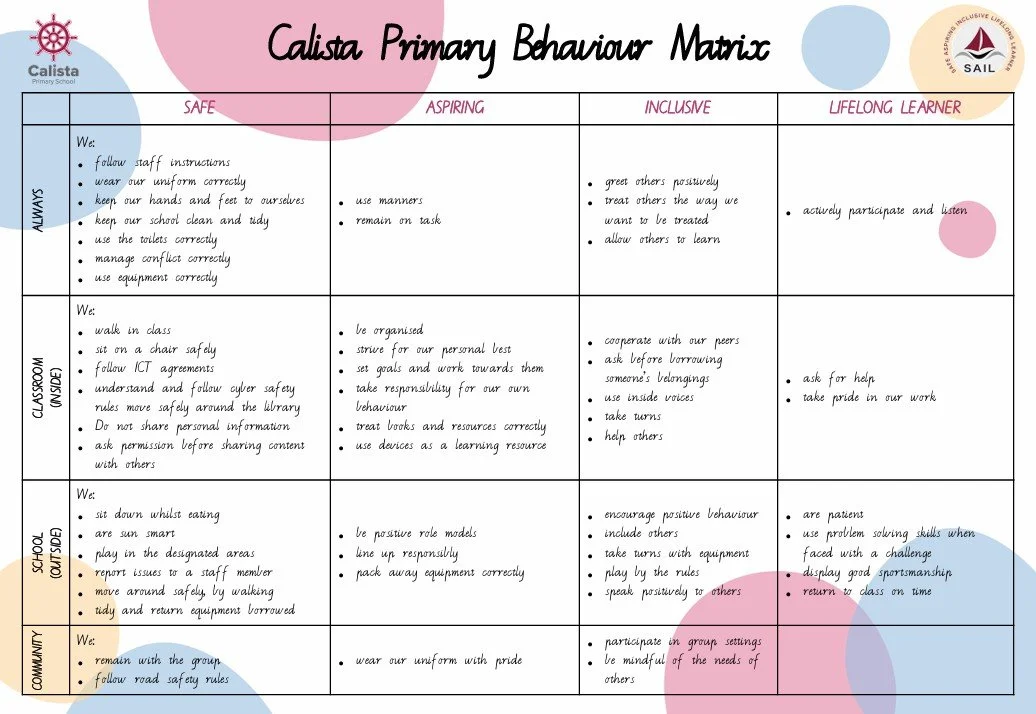
“To provide a safe and supportive environment which prepares students for success” Calista Primary School follows the Positive Behaviour Support (PBS) model. PBS is a Western Australian Education Department endorsed program, which aims to promote and support positive behaviour in schools. The Calista Primary School PBS team has been established to create a sustainable and effective school-wide approach to behaviour management and bullying. Calista Primary School has developed a behaviour matrix with four clear values; Safe, Aspiring, Inclusive and Life-long learner . A matrix has been developed that breaks down each value into key expectations that students are explicitly taught. Each fortnightly we focus on one expectation from the behaviour matrix. The behaviour expectation is explicitly taught on Monday mornings, posters are displayed in every classroom and expectations are reinforced at school assemblies.
The Positive Behaviour Support team is made up of a diverse group of Calista staff from administration and various year levels, each contributing unique perspectives and experience to our school community. Our team members include Joshua Atkinson, Brendan Wall, Cathy de Thierry, Michael Milbourne, Shane Aitken, Brody Capewell, Jenifer Te Hemara, Brittany Tyson, Sarah Thomas, Sandy Atkinson, Alissa de Souza and Ben Mowe.
PBS BEHAVIOUR MATRIX
A vital part of the process is to create a behaviour matrix that aligns to Calista Primary School. Schools have curricula to guide the teaching of every learning; in WA PBS, behaviour is a learning area and requires the development of a behaviour curriculum. The behaviour matrix becomes the basis for all future work as PBS is planned for and implemented. The matrix reflects the language and culture of Calista Primary School. It is the language that all staff use when they teach and reinforce the expectations.
captains club
Captain’s Club is an award that acknowledges students with exceptional behaviour. These students are driven by our core values of being safe, aspiring, inclusive and life-long learners. This award will continue to be presented every semester. Students and teachers have the opportunity to vote for students in the school who they believe are role models to the school community, consistently driven by being Safe, Aspiring, Inclusive and a Lifelong Learner. Students who are successful are awarded a special certificate and an enamel badge at school assemblies and community events. Recipients of the Captain’s Club are invited to special lunches with the Principal, as well as Deputy Principals and any available leadership members.